
Comprehensive clinical examination
The mouth, missing tooth or teeth, gums, bite, existing restorations, anatomy and treatment objectives are assessed before a surgical plan is made.
AMAYRA DENTAL EDUCATION • IMPLANT TECHNOLOGY
Understand how 3D CBCT imaging, virtual implant planning and computer-generated surgical guides can help clinicians plan implant placement around the final restoration.
Clinical guide source: January 2022. This article should be clinically reviewed before production publication.
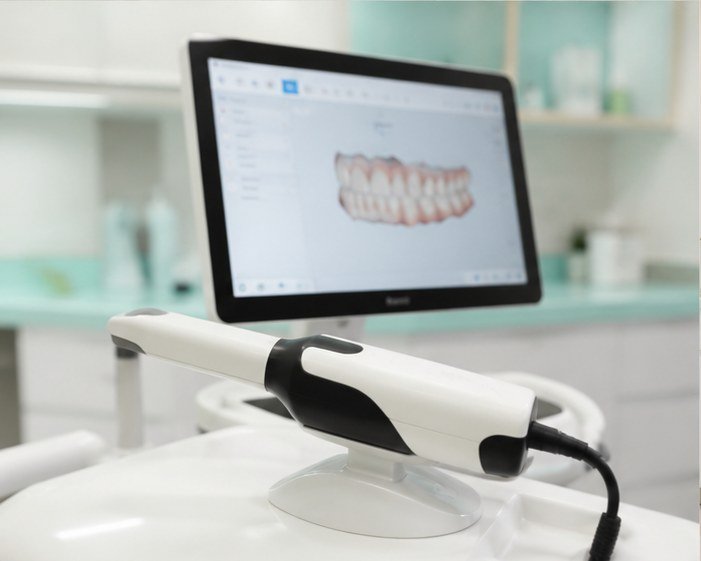
3D digital guided implant surgery combines three-dimensional imaging, virtual treatment planning and computer-generated surgical guides to plan implant position before surgery. The source guide describes a workflow that brings together CBCT imaging, digital intraoral scanning, virtual prosthetic design, computer planning software, CAD/CAM surgical guides, guided implant placement and digital prosthetic fabrication.
The aim is not simply to find a place where an implant can fit. The planning process considers where the future tooth should function and appear, then uses that restorative goal to guide implant positioning.
Start with our broader Dental Implants in Pune: Complete Guide, which covers candidacy, the implant procedure, full-mouth solutions, cost factors, recovery and longevity. This article goes deeper into the digital planning side of implant treatment.
The digital workflow described in Dr. Rupali's guide begins with diagnosis and three-dimensional records and ends with guided implant placement and the planned restoration.
The mouth, missing tooth or teeth, gums, bite, existing restorations, anatomy and treatment objectives are assessed before a surgical plan is made.
Three-dimensional CBCT imaging and digital intraoral records provide information about bone volume, anatomical landmarks and the planned restorative space.
The implant position, angulation and depth can be planned virtually, taking the intended prosthetic restoration into account.
A CAD/CAM-manufactured guide can be designed to transfer the planned implant position to the clinical procedure.
The implant is placed according to the planned protocol, followed by digital verification and the restorative stage as appropriate.
According to Dr. Rupali's guide, 3D CBCT imaging allows the implant team to evaluate structures that may not be fully represented on conventional two-dimensional dental X-rays.
This information can help clinicians identify anatomical challenges before implant placement and plan the treatment around the patient's individual anatomy.
Implant position influences stability, aesthetics, chewing function and the design and maintenance of the final restoration. The source guide notes that inaccurate positioning can contribute to issues such as poor load distribution, difficulty cleaning around implants, gum recession, food impaction, prosthetic screw loosening, crown fracture, bone loss, aesthetic compromise and proximity-related injury to neighbouring structures.
A prosthetically driven approach therefore asks not only “Where can an implant fit?” but also “Where should the final tooth ideally be positioned?” The implant is then planned to support that restorative goal.
Digital guidance and conventional freehand placement are different planning approaches. The source guide notes that both can achieve good clinical outcomes when performed by experienced clinicians; the major distinction is how much planning is completed before surgery versus during the procedure.
| Planning feature | Computer-guided approach | Conventional freehand approach |
|---|---|---|
| Preoperative planning | Comprehensive digital planning | More dependent on clinical judgement during treatment |
| CBCT integration | Integrated into the digital workflow | Use varies by case and workflow |
| Surgical guide | Custom CAD/CAM guide may be used | Usually not used |
| Implant angulation | Digitally planned and controlled | Operator-dependent positioning |
| Prosthetic planning | Can be planned before surgery | May be finalised later in the workflow |
Digital guidance does not replace surgical expertise. It provides additional anatomical information and a structured way to translate the planned position into treatment.
The source guide identifies several situations where digital guidance may provide additional planning value:
Not every implant requires a surgical guide. The guide notes that straightforward single-tooth replacements with sufficient bone may be successfully treated using conventional techniques.
The source guide describes the principal benefit of guided surgery as improved implant-positioning accuracy and treatment predictability. It also emphasises that no technique guarantees success and that long-term implant outcomes depend on diagnosis, surgical skill, appropriate patient selection, implant systems, prosthetic planning, maintenance and patient cooperation.
For that reason, it is more useful to think of digital guidance as a planning and execution aid rather than a guarantee of a successful result.
Many potential challenges can be identified during planning rather than discovered unexpectedly during surgery. Three-dimensional planning can help the clinical team assess limited bone volume, sinus anatomy, nerve pathways and prosthetic space before treatment begins.
The guide specifically explains that guided surgery cannot eliminate every complication. Potential problems may still include delayed healing, infection, failure of integration, bone loss, mechanical or prosthetic complications and medical factors affecting healing.
Three-dimensional imaging can provide a clearer picture of the available anatomy when bone is limited. The source guide explains that this information can help determine whether conventional implants, bone grafting, zygomatic implants or another treatment approach should be considered.
For a broader discussion of implant candidacy, bone grafting, zygomatic implants and full-mouth solutions, see the Complete Guide to Dental Implants in Pune.
Recovery depends on the complexity of treatment. The source guide notes that carefully planned guided procedures may involve less surgical manipulation in selected cases and may therefore be associated with a comfortable recovery, but patients undergoing full-mouth rehabilitation or bone grafting should still expect a longer healing period than patients receiving a straightforward single implant.
Dr. Rupali's guide states that Amayra Dental Clinic in Pune uses an in-house 3D CBCT scanner, Digital Smile Design software and computer-guided surgical planning as part of its implant workflow. The source describes this approach as being used for cases including challenging anatomy, previous implant failures and severe bone loss.
For patients considering implants, the practical question is not simply whether a clinic has digital technology. It is how the technology is integrated with diagnosis, surgical judgement and the final restoration.
Discuss whether 3D CBCT and guided planning are appropriate for your particular case before choosing a treatment approach.
For many patients, the value of digital guidance lies in the ability to plan implant position, anatomy and the final restoration before surgery. The benefit may be especially relevant in complex cases where several implants, limited bone, aesthetic demands or important anatomical structures are involved.
Patients considering guided treatment can ask:
The source guide describes guided surgery as providing greater positional control because placement follows a pre-planned digital protocol based on three-dimensional imaging. The actual approach should still be selected for the individual case.
No. The guide explicitly states that no technique guarantees success. Long-term outcomes also depend on diagnosis, surgical expertise, patient selection, implant and restorative planning, maintenance and patient factors.
The guide describes CBCT as an important source of three-dimensional anatomical information for modern implant planning. Whether and what imaging is required should be determined by the treating clinician.
Three-dimensional planning can help identify the location of important anatomical structures before surgery, which may help the clinician plan around them. It does not eliminate surgical risk.
The source guide identifies full-mouth rehabilitation as one of the situations where digital planning and computer-guided placement can be particularly valuable.
3D imaging can help assess available anatomy and support planning when bone is limited. The treatment may involve grafting, zygomatic implants or another approach depending on the case.
Yes, it may be used in selected single-tooth cases, particularly where precise implant positioning has important aesthetic or restorative implications.
In carefully selected cases, minimally invasive or flapless techniques may be possible, but they are not appropriate for every patient.
The principle is that the implant should support the final tooth or restoration. Planning therefore begins with the intended restorative result and works backward to the implant position.
3D digital guided implant surgery brings imaging, virtual planning, surgical guidance and restorative planning into a coordinated workflow. Its purpose is not to replace the clinician's judgement, but to provide detailed information and a planned pathway for implant placement.
If you are exploring dental implants, start with our Dental Implants in Pune: Complete Guide and then use this article to understand the digital planning process in greater depth.
Bring your questions about CBCT, guided surgery, implant positioning and restoration planning to an individual assessment.
Dr. Rupali's source guide identifies the International Congress of Oral Implantologists (ICOI), American Academy of Implant Dentistry (AAID) and Indian Dental Association (IDA) as resources for further evidence-based implant information.
IMPLANT RESOURCE CLUSTER
3D DIGITAL GUIDED IMPLANT SURGERY • PUNE
Discuss your missing tooth or teeth, imaging needs and treatment options with the Amayra team.
TRUSTED PARTNERS